Two new yard birds in the span of 24 hours. Not bad!
#58 - Cedar Waxwing. I know, it's a very common garden bird for a lot of people, but it's a first in ours.
#59 - Pine Siskin. This guy has been hanging out with the Goldfinches and House Finches, and I thought it was a female House Finch. But then I got a better look at it, and I realized the beak was completely wrong and it had a yellow tint to its wings.
Yesterday morning I was outside trying to get some more pictures of my tree swallows, and I got to witness the babies fledge! It was pretty special to be able to see these little guys take flight for the first time ever. I felt a bit like a proud mom. They spent about half an hour working up their courage - first squeezing their shoulders out of the hole, then perching there with their little feet grasping the ledge, and then - jump and lift off! Now they're gone, and the nesting box will be empty until next spring. Maybe one of those babies will come back and start a family of its own. :)
I also reached new levels of bird nerdiness yesterday. I bought a small photography blind to set up in the backyard to allow me to photograph our birds more closely without disturbing them. Tried it out yesterday afternoon, and from a preliminary review of my pictures, I'd say it was a success! (That's actually how I realized the Pine Siskin wasn't a House Finch - I was able to get some pretty close-up pictures of it in our pond.) So we'll see how this works out. Hopefully I'll be able to get some pictures of yard birds who have eluded me so far - like the Rose-breasted Grosbeaks and House Finches. I also really, really want to get some good Oriole pictures - NOT with them sitting on the feeder. Wish me luck!
Showing posts with label photography. Show all posts
Showing posts with label photography. Show all posts
Sunday, June 24, 2012


Wednesday, March 28, 2012
Published!
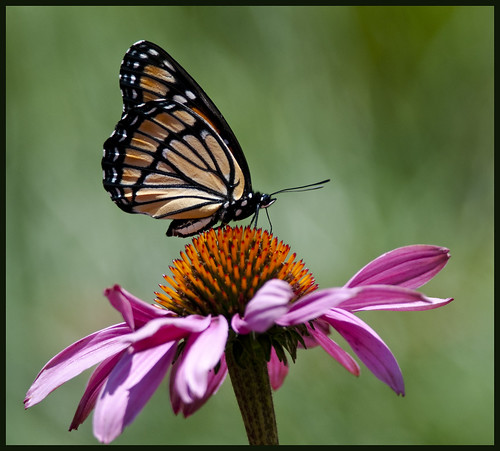
I received a lovely surprise in the mail yesterday from the Canadian Wildlife Federation. I'd submitted some images to a competition of theirs back in November, and while I didn't place at all, they chose one of my photos to include in their April issue of WILD magazine.
It was this photo of a Viceroy butterfly on a coneflower:

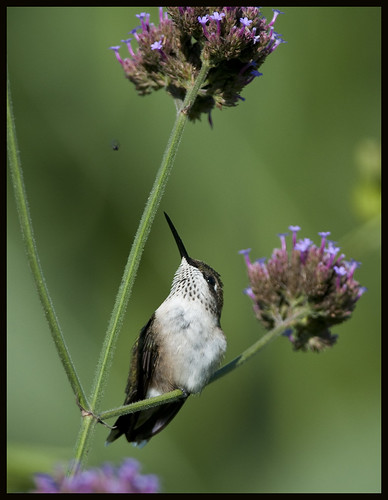
And earlier this year, I found out two of my images submitted to a competition hosted by Cornell Lab of Ornithology's Celebrating Urban Birds calendar.
This cardinal was January:

And this hummer shared one of the summer months, but I can't remember which one off the top of my head.

So yay! I guess I can now say I'm a published photographer. :)
It was this photo of a Viceroy butterfly on a coneflower:
And earlier this year, I found out two of my images submitted to a competition hosted by Cornell Lab of Ornithology's Celebrating Urban Birds calendar.
This cardinal was January:

And this hummer shared one of the summer months, but I can't remember which one off the top of my head.
So yay! I guess I can now say I'm a published photographer. :)
Friday, March 02, 2012
Spring is in the air
Happy March!
As much as I love my winter birds, I'm really looking forward to Spring migration. I'm anxious to get my garden cleaned up and start planting... which is nuts, considering we've still got two-foot-deep snow drifts in parts of our yard, and the Horned Larks are still singing away in our fields. (I love listening to them when I'm out in the yard with the pup. Such a pretty sound.)
Regardless, though, I saw my first signs of Spring this week: the maple trees around us are being tapped for syrup, and I saw a robin fly across the road on my to work yesterday. Yeah, yeah, I know, some robins are over-wintering here now. But I'm going to go with it being a migrant. Makes me feel better. ;-)
I also watched Mr. Northern Cardinal attack his reflection in my car's side-view mirror this morning. I figure that's a sign that he's ready to start fighting for mating rights.
The downside to Spring is that all of a sudden we've got flocks of Starlings taking over our feeders. I hate those birds so, so, sooooo much. Them and the House Sparrows. Ugh. The Starlings are also brilliant mimics, and have fooled me and Dave more than once. They have a stellar red-tailed hawk cry, and lately they've been singing the first few notes of the male cardinal's call.
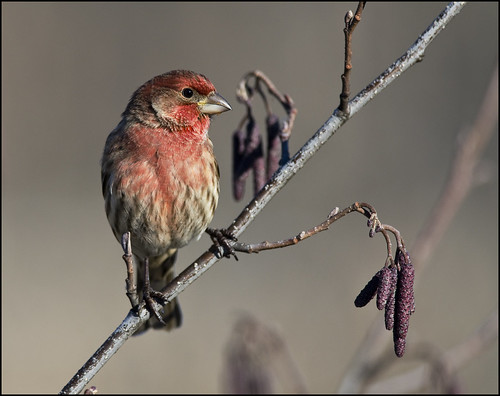
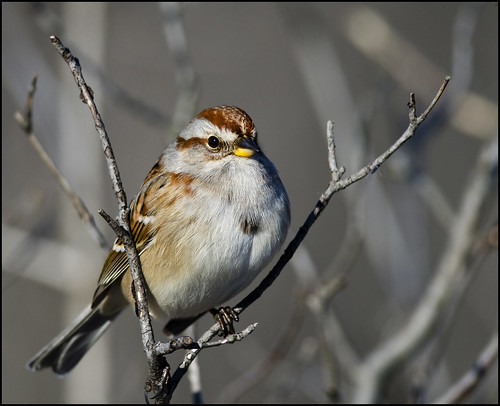
Haven't been taking many pictures around the yard, but I've been visiting a really lovely park down in Cambridge and getting some nice shots of the usual winter suspects - Black-capped Chickadees, American Tree Sparrows, Northern Cardinals, White-breasted Nuthatches. I even saw a beautiful male House Finch a few weeks back, and a Song Sparrow. It's early for a Song Sparrow, I think, but since the winter's been so mild, maybe it's not that unusual.
Here are a couple of my faves:


As much as I love my winter birds, I'm really looking forward to Spring migration. I'm anxious to get my garden cleaned up and start planting... which is nuts, considering we've still got two-foot-deep snow drifts in parts of our yard, and the Horned Larks are still singing away in our fields. (I love listening to them when I'm out in the yard with the pup. Such a pretty sound.)
Regardless, though, I saw my first signs of Spring this week: the maple trees around us are being tapped for syrup, and I saw a robin fly across the road on my to work yesterday. Yeah, yeah, I know, some robins are over-wintering here now. But I'm going to go with it being a migrant. Makes me feel better. ;-)
I also watched Mr. Northern Cardinal attack his reflection in my car's side-view mirror this morning. I figure that's a sign that he's ready to start fighting for mating rights.
The downside to Spring is that all of a sudden we've got flocks of Starlings taking over our feeders. I hate those birds so, so, sooooo much. Them and the House Sparrows. Ugh. The Starlings are also brilliant mimics, and have fooled me and Dave more than once. They have a stellar red-tailed hawk cry, and lately they've been singing the first few notes of the male cardinal's call.
Haven't been taking many pictures around the yard, but I've been visiting a really lovely park down in Cambridge and getting some nice shots of the usual winter suspects - Black-capped Chickadees, American Tree Sparrows, Northern Cardinals, White-breasted Nuthatches. I even saw a beautiful male House Finch a few weeks back, and a Song Sparrow. It's early for a Song Sparrow, I think, but since the winter's been so mild, maybe it's not that unusual.
Here are a couple of my faves:



Thursday, August 25, 2011
Owls Obsessed
As a follow-up to my post yesterday, I've published my third bird photography book, Owls Obsessed. Click on the window below to preview.
The 20% off deal is still valid on Blurb.com. Simply order two or more books (any titles, any authors, not just mine) and enter the promo code AUGUST when prompted during the checkout process, and you'll save 20% off your entire order.
The 20% off deal is still valid on Blurb.com. Simply order two or more books (any titles, any authors, not just mine) and enter the promo code AUGUST when prompted during the checkout process, and you'll save 20% off your entire order.
Wednesday, August 24, 2011
New book - Feathered Jewels
I've published my second book through Blurb.com: Feathered Jewels, Ruby-throated Hummingbirds.
In case you're interested, Blurb has a special discount offer for the rest of this week. Simply order two or more books (any titles) and you'll save 20%. Just enter the promo code AUGUST when you check out.
In case you're interested, Blurb has a special discount offer for the rest of this week. Simply order two or more books (any titles) and you'll save 20%. Just enter the promo code AUGUST when you check out.
Tuesday, August 23, 2011
Photographing hummingbirds
I've had more than a handful of people ask me how I manage to get so many post-able hummer shots, so I thought I'd share what I can. Honestly, a lot of it is luck and the fact that I've got access to so many hummers throughout the summer, so I have a lot of time to practice. My tips and tricks aren't big secrets, and they're nothing special, but they've worked for me these past two summers.
1. Attract
Yes, this may sound obvious, because you can't take pictures of birds you don't have access to. So if at all possible, make your yard and garden as attractive to hummers as possible. Place nectar feeders in different spots around the yard. Make sure your garden has a good selection of nectar-rich (native, if possible) flowers that hummers love. The more hummingbirds you have, the better your chances are of getting some good shots.
2. Observe
Hummers, like a lot of birds, develop patterns of behavior that, once you've learned, give you a better chance of being at the right place at the right time. So watch the birds in your yard. Do they hang out in a couple of particular spots? Do they seem to prefer a certain feeder? Are they more active at certain times of the day? Do they perch on the feeder, or do they hover and move in and out to drink?
Also take careful note of the area you're shooting in. Where's the best light at certain times of day? What angles give you the best background? It's amazing how you can sometimes have a completely crap background and then move a step to either side and it's perfect. Are there stray branches or leaves that could get in your way?
3. Be patient
This applies two-fold: be patient with the birds and be patient with yourself.
Birds are wild animals and you can't control them. The sooner you accept that, the better. Some days they'll be cooperative and put on a show that blows you away and lets you fill media card after media card, others they'll frustrate the hell out of you by making it impossible to snap even one shot, let alone a decent one.
I can also promise that you'll get a lot more throw-away shots than keepers. I guarantee it. The other night, I went into the backyard and shot more than 1200 frames over the span of an hour and a half. I got maybe 25 shots that I considered good enough to show people. It could take you a while to get into a rhythm, to learn to hone your reaction time to get the little guys at just the right time and just the right spot. You'll miss a lot, I promise you that, so don't beat yourself up over it.
4. Experiment
Each camera and lens set-up will be different, as will your preference. But I'll tell you what works for me. After some trial and error and more hummer photos than I care to admit to, this is the default I fall back on.
Now, there are a few different schools of thought on the technical side of the picture. Quite frankly, as long as the eye is sharp and there's some definition to the wings (for an in flight shot), I figure the rest is up for debate. When you're using a wide open f-stop, your depth of field is so narrow that unless you get the bird completely side on, most of the bird will be soft. And honestly, the perfectly side-on shots don't tend to be the most exciting ones (says the girl with a lot of those in her portfolio). I prefer the three-quarter views, or angled bodies while they feed on a flower - it adds so much interest to the shot. Some people like wing blur, some people hate it. Yes, frozen wings are always very cool, but I happen to think wing blur gives a nice feeling of movement. I know a lot of people would argue with me, but to each his or her own, I say.
I use a Nikon D90, and my birding lens of choice is a 300mm f4 paired with a 1.4x teleconverter. Because this lens doesn't have any kind of built-in stabilization, I always have my camera on a tripod. I hated the idea of being stuck to a tripod when I first got this lens, but I've since made peace with it - and in fact, I love it. I suspect that even if it did have stabilization, though, I'd use a tripod more often than not, because it allows me better control to make small, smooth movements to follow the ridiculously quick and spazzy hummers. (I also have very unsteady hands, so...)
My minimum f stop with that set-up is 5.6, so that's what I go with so I can get the fastest shutter speed at the lowest ISO, and I set the camera to Aperture mode. I try not to increase my ISO from the default 200, because I get annoying noise at 400 and above. I usually just don't bother trying to get in flight shots on days with less light - that's when I go for perched shots, if anything.
The most important thing, in my humble opinion? Burst mode. Don't try to conserve your shutter actuations. )I'd rather wear my camera out - which I'm very close to doing, as a matter of fact - than be disappointed by missing opportunities for a great shot.) Burst mode will be your best friend, because you'll increase your chances of getting a nice, sharp shot exponentially.
So, to summarize, my default settings for all bird photography, not just hummers, are:
f/5.6 (if using the 300mm and TC, otherwise I use the widest f-stop possible)
ISO 200 (or the lowest you can use while still getting the shutter speed you want)
Aperture mode
Burst mode
Single point auto focus
So I'll end this entry with three words of advice: Don't give up. Hummingbirds are a challenge to photograph for many reasons, not the least of which being their small size and incredible speed. But with practice and patience, you'll get there. :)
1. Attract
Yes, this may sound obvious, because you can't take pictures of birds you don't have access to. So if at all possible, make your yard and garden as attractive to hummers as possible. Place nectar feeders in different spots around the yard. Make sure your garden has a good selection of nectar-rich (native, if possible) flowers that hummers love. The more hummingbirds you have, the better your chances are of getting some good shots.
2. Observe
Hummers, like a lot of birds, develop patterns of behavior that, once you've learned, give you a better chance of being at the right place at the right time. So watch the birds in your yard. Do they hang out in a couple of particular spots? Do they seem to prefer a certain feeder? Are they more active at certain times of the day? Do they perch on the feeder, or do they hover and move in and out to drink?
Also take careful note of the area you're shooting in. Where's the best light at certain times of day? What angles give you the best background? It's amazing how you can sometimes have a completely crap background and then move a step to either side and it's perfect. Are there stray branches or leaves that could get in your way?
3. Be patient
This applies two-fold: be patient with the birds and be patient with yourself.
Birds are wild animals and you can't control them. The sooner you accept that, the better. Some days they'll be cooperative and put on a show that blows you away and lets you fill media card after media card, others they'll frustrate the hell out of you by making it impossible to snap even one shot, let alone a decent one.
I can also promise that you'll get a lot more throw-away shots than keepers. I guarantee it. The other night, I went into the backyard and shot more than 1200 frames over the span of an hour and a half. I got maybe 25 shots that I considered good enough to show people. It could take you a while to get into a rhythm, to learn to hone your reaction time to get the little guys at just the right time and just the right spot. You'll miss a lot, I promise you that, so don't beat yourself up over it.
4. Experiment
Each camera and lens set-up will be different, as will your preference. But I'll tell you what works for me. After some trial and error and more hummer photos than I care to admit to, this is the default I fall back on.
Now, there are a few different schools of thought on the technical side of the picture. Quite frankly, as long as the eye is sharp and there's some definition to the wings (for an in flight shot), I figure the rest is up for debate. When you're using a wide open f-stop, your depth of field is so narrow that unless you get the bird completely side on, most of the bird will be soft. And honestly, the perfectly side-on shots don't tend to be the most exciting ones (says the girl with a lot of those in her portfolio). I prefer the three-quarter views, or angled bodies while they feed on a flower - it adds so much interest to the shot. Some people like wing blur, some people hate it. Yes, frozen wings are always very cool, but I happen to think wing blur gives a nice feeling of movement. I know a lot of people would argue with me, but to each his or her own, I say.
I use a Nikon D90, and my birding lens of choice is a 300mm f4 paired with a 1.4x teleconverter. Because this lens doesn't have any kind of built-in stabilization, I always have my camera on a tripod. I hated the idea of being stuck to a tripod when I first got this lens, but I've since made peace with it - and in fact, I love it. I suspect that even if it did have stabilization, though, I'd use a tripod more often than not, because it allows me better control to make small, smooth movements to follow the ridiculously quick and spazzy hummers. (I also have very unsteady hands, so...)
My minimum f stop with that set-up is 5.6, so that's what I go with so I can get the fastest shutter speed at the lowest ISO, and I set the camera to Aperture mode. I try not to increase my ISO from the default 200, because I get annoying noise at 400 and above. I usually just don't bother trying to get in flight shots on days with less light - that's when I go for perched shots, if anything.
The most important thing, in my humble opinion? Burst mode. Don't try to conserve your shutter actuations. )I'd rather wear my camera out - which I'm very close to doing, as a matter of fact - than be disappointed by missing opportunities for a great shot.) Burst mode will be your best friend, because you'll increase your chances of getting a nice, sharp shot exponentially.
So, to summarize, my default settings for all bird photography, not just hummers, are:
f/5.6 (if using the 300mm and TC, otherwise I use the widest f-stop possible)
ISO 200 (or the lowest you can use while still getting the shutter speed you want)
Aperture mode
Burst mode
Single point auto focus
So I'll end this entry with three words of advice: Don't give up. Hummingbirds are a challenge to photograph for many reasons, not the least of which being their small size and incredible speed. But with practice and patience, you'll get there. :)
Subscribe to:
Posts (Atom)